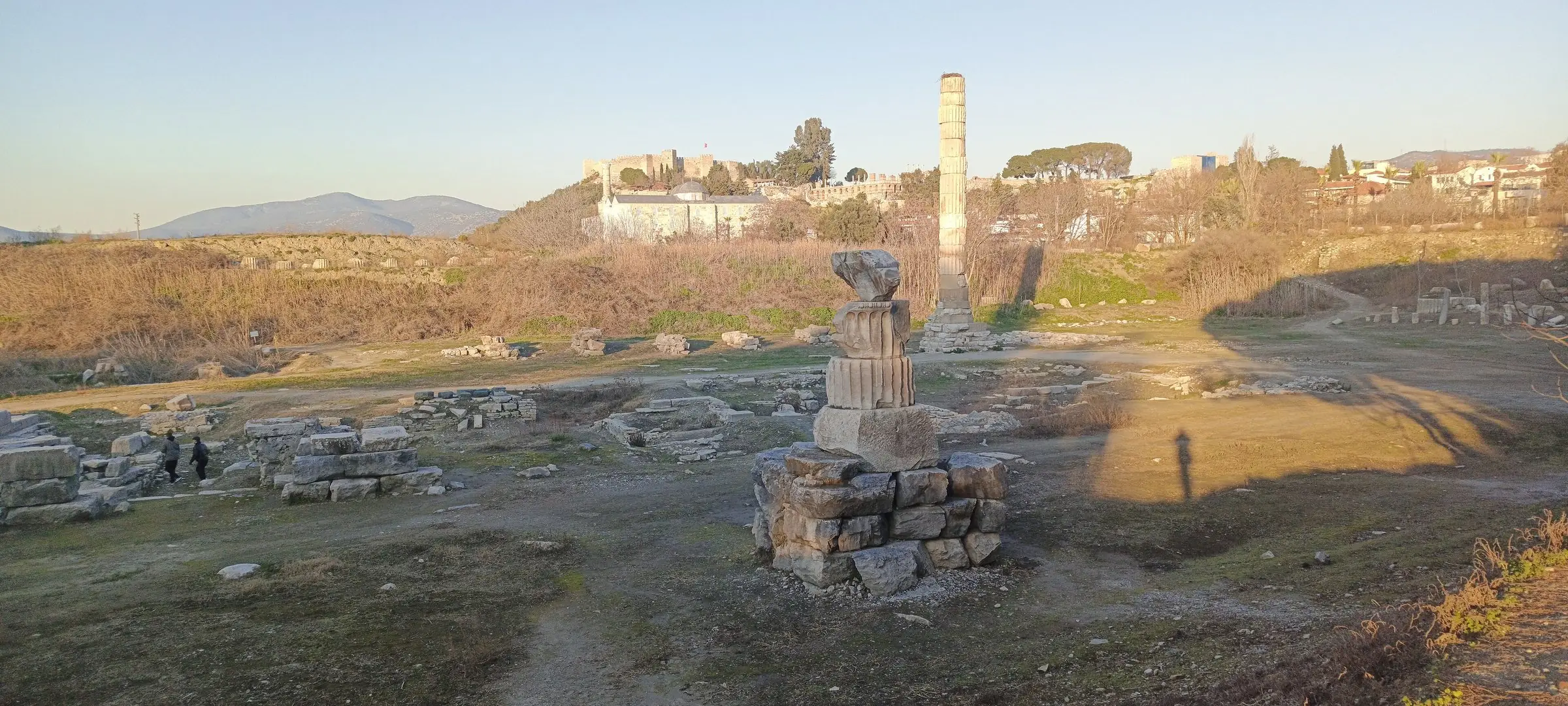
Be prepared: there is one column, and it is not even entirely genuine — it was put together in the 1970s from drums that did not necessarily belong to each other, to roughly the original height. Storks nest on top of it.
Everybody who comes here is disappointed for about ninety seconds, and then something better happens.
Why to stop anyway
Stand at the column and turn to face the hill. In one view, in the order they arrived, you can see:
- the Artemision, foundations under water in the foreground — Greek, seventh century BC onwards
- the Basilica of St John on the slope above — Byzantine, sixth century AD
- the İsa Bey Mosque below it — Turkish, 1375
- the Ayasuluk fortress on the summit
Four religions and two thousand years, stacked up a single hillside, from a spot that was the richest temple in the Greek world.
That is what the visit is. Not the ruin — the sightline.
Practical
- Free, always open in daylight, no ticket office
- on the Efes road between Selçuk and the archaeological site, five minutes' drive from either
- a car park, a couple of stalls, a boardwalk over the wet ground
- ten minutes is enough; fifteen if you read the panel
The field floods in winter, which is part of why the temple's foundations were a problem from the start.
Where the good bits went
The carved column drums that survived are in the British Museum, excavated by John Turtle Wood in the 1870s. The full story is here.
Is there anything left of the Temple of Artemis?
One reassembled column, some foundations under water, and a boardwalk. The best surviving carved drums are in the British Museum.
Is the Temple of Artemis free?
Yes. There is no ticket office; it is open in daylight and takes about ten minutes.