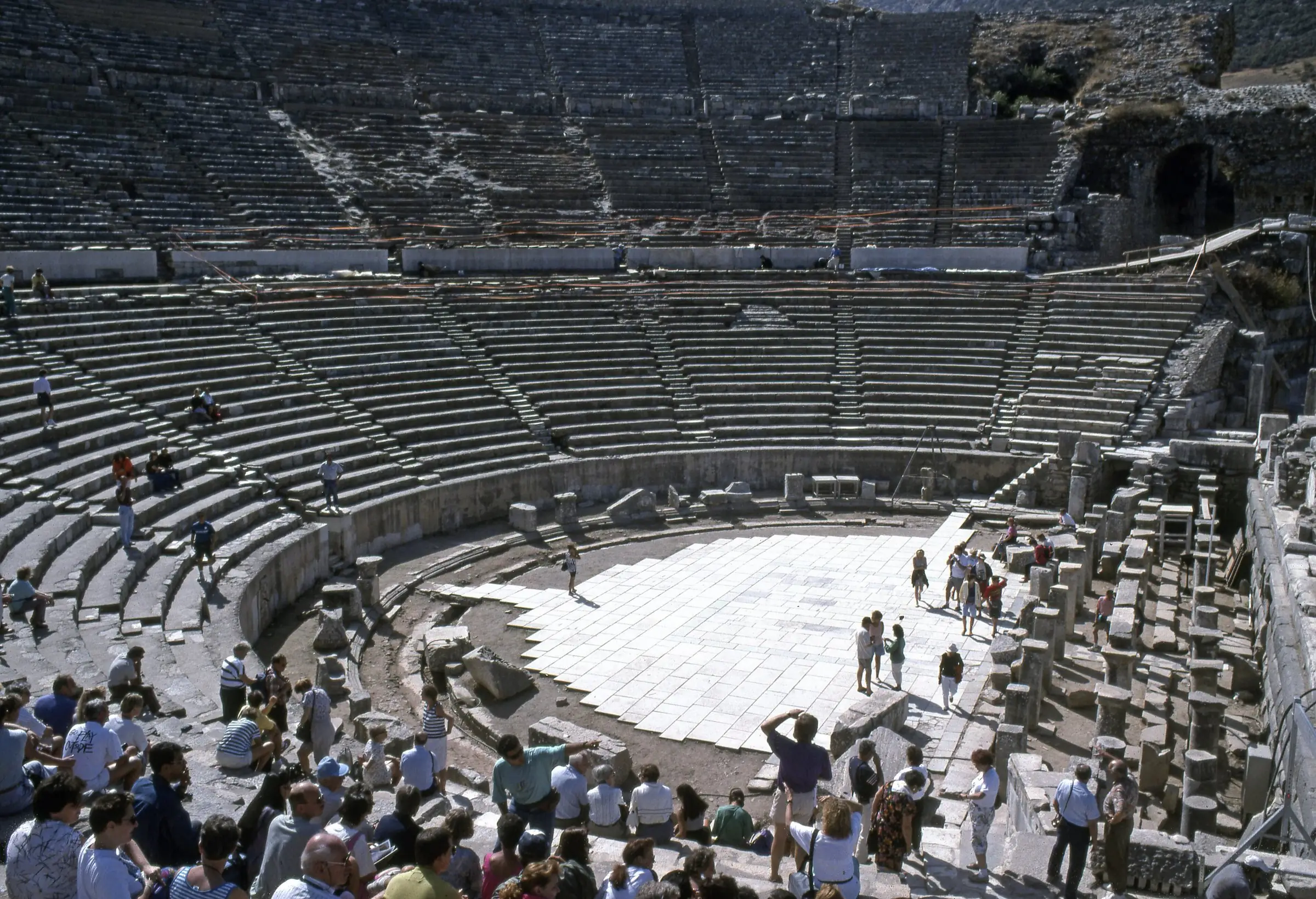
It is the biggest thing at Ephesus and it is easy to underrate, because you meet it from the bottom, where it looks like a large curved wall.
Climb it. Not to the top — the upper tier is fenced — but far enough up the middle tier that you are looking down on the stage rather than across at it. From there the theatre stops being a monument and becomes a room.
The numbers
About 25,000 seats, in three tiers, on a diameter of roughly 145 metres, cut into the western face of Mount Pion. The Greeks began it in the third century BC; the Romans rebuilt and enlarged it through the first and second centuries AD, raising the stage building to three storeys and giving it a decorated front that has mostly gone.
Later still it was adapted for gladiatorial and animal shows: the lowest rows were removed and a barrier put up. A gladiator cemetery was excavated near the site, and the injuries on the bones are one of the better sources we have for how those men actually died.
The riot
Acts 19 describes a silversmith called Demetrius, who made souvenir shrines of Artemis and found his trade falling off as Paul preached in the city. He got the trade together, and the crowd took hold of two of Paul's companions and rushed into the theatre, where they shouted Great is Artemis of the Ephesians for two hours until the town clerk talked them down.
Whatever you make of the source, the account is unusually specific about civic procedure — the clerk points out that there are courts and proconsuls and that an unlawful assembly could get the city into trouble with Rome. This is the room that happened in, and it is the reason a good share of visitors to Ephesus are here at all.
The acoustics
They are good, and everyone tests them. Someone will be standing in the middle of the orchestra singing. The effect is real: the stone bowl reflects sound upward and the shape does the rest.
What to look at from up there
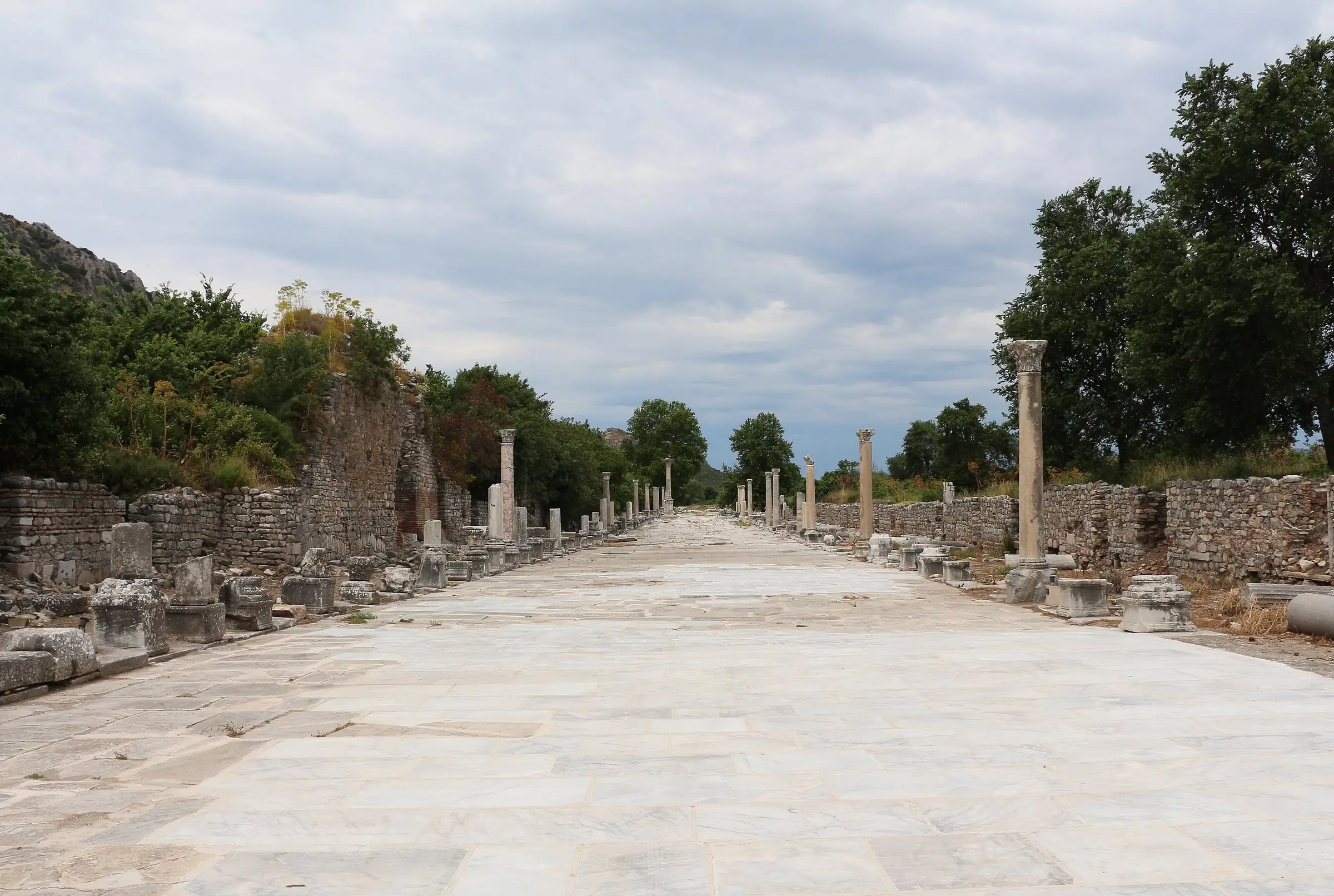
Turn round. Below you, Harbour Street runs dead straight away from the theatre towards a flat green plain with a line of trees along it.
That plain is the harbour. Ephesus was a port — that is the entire reason for the city — and the sea used to come up to the end of that road. The Cayster river filled it in, silt by silt, faster than the Ephesians could dredge it out, and the coast is now five kilometres away.
Standing at the top of the theatre is the only place on the site where you can see the shape of the problem that killed the city. The long version is here.
Practical
The climb is steep and the steps are uneven and high — this is the hardest ten minutes of physical effort at Ephesus, and there is no shade. If it is thirty-five degrees, do it early or do not do it.
How many people did the Ephesus theatre hold?
About 25,000, in three tiers on a diameter of roughly 145 metres. The top tier is closed to visitors.
Can you climb the theatre at Ephesus?
You can climb the lower and middle tiers. The steps are high and uneven, there is no shade, and it is the most demanding part of the site physically.
Is this where the riot in Acts 19 happened?
Yes. The account describes the crowd rushing into the theatre and shouting for two hours, and this is the theatre it means.