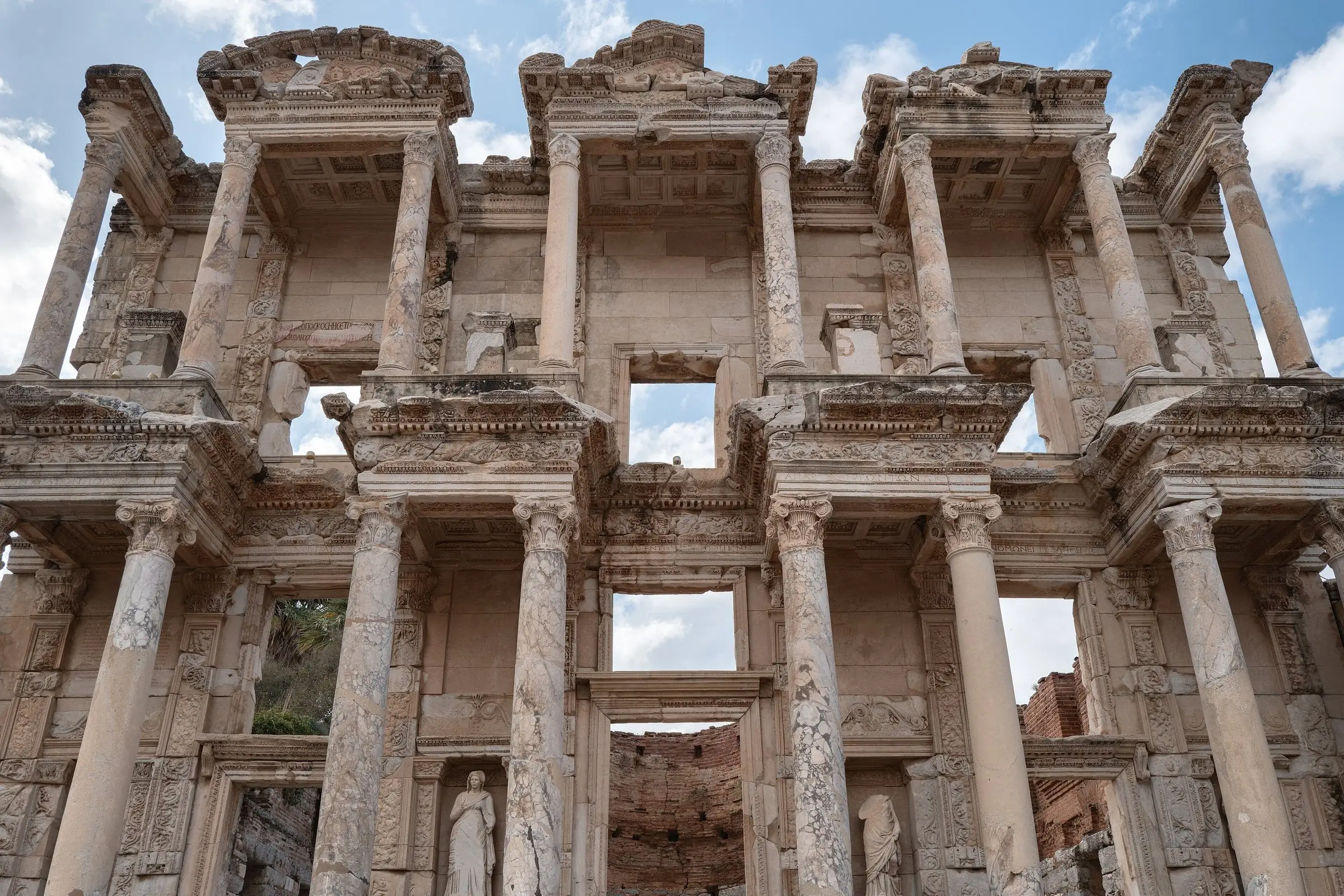
It is the image of Ephesus, and it is the most misunderstood building on the site. Not because of what it is — a library, which is what everybody says — but because of what it is doing.
A tomb with a library on top
Tiberius Julius Celsus Polemaeanus came from Sardis, made a senatorial career in Rome, was consul in AD 92 and ended as proconsul of Asia — the governor of the province Ephesus was the capital of. He died around AD 114.
His son, Tiberius Julius Aquila, built this in his memory and endowed it with money to buy books. Celsus was buried inside it, in a marble sarcophagus in a vaulted chamber directly beneath the reading room floor. That was unusual to the point of requiring special permission: Roman cities did not allow burials inside the walls, and a grave in a public building on the main square was a considerable favour.
The sarcophagus is still there. You can see the entrance to the vault at the foot of the façade.
The trick in the façade
Stand in the square in front and look at it properly.
The columns at the two ends are shorter than the ones in the middle, and their bases are smaller. The platform they stand on curves very slightly upward towards the centre. The niches between the columns get narrower as they go outward. The upper storey is set back and its columns straddle the gaps of the lower storey rather than sitting above them.
None of this is decoration. It is perspective, applied deliberately, so that a façade about 21 metres wide reads as wider and taller than it is, and so that the eye is pushed towards the central door. The building is a piece of stage design that happens to be made of marble.
The four women
In the niches on the lower storey stand four statues, personifications of the qualities the inscription claims for Celsus: Sophia (wisdom), Arete (excellence), Ennoia (judgement) and Episteme (knowledge).
The ones on the building are casts. The originals were taken to Vienna after the Austrian excavations of 1903–04 and are in the Kunsthistorisches Museum there.
How much of this is old
More than you would guess, and it is honestly signposted if you know what to look for.
The interior burned — probably in the Gothic raid of AD 262 — and the façade fell in a later earthquake and lay in pieces for centuries. Between 1970 and 1978 the Austrian Archaeological Institute rebuilt it by anastylosis: sorting the fallen blocks, working out where each one had been, and putting them back. The work was directed by Volker Michael Strocka, on the basis of the fragments the 1903–04 excavation had recorded.
Around 750 original blocks went back into the building. Where a piece was missing it was replaced in new stone, left plainer and slightly paler, so the join is visible. Look along the entablature and you can pick out the modern sections.
The story about the tunnel
You will be told that a secret tunnel ran from the library to the brothel across the street, so that men could tell their wives they were going to read.
There is no tunnel. There is a drain, and there is a Roman city's normal density of buildings, and there is a joke that has been repeated so often it has become a fixture of the tour. It is a good joke. It is not true.
Where to stand
The clean straight-on shot is from the middle of the square, back towards the Commercial Agora gate, which means turning round after you have walked down Curetes Street. In the morning the sun is on the façade and the crowd is at its worst between about ten and one, when the ships are in. Late afternoon gives you softer light, shade creeping across the lower storey, and perhaps a third of the people.
Is anyone buried in the Library of Celsus?
Yes. Tiberius Julius Celsus Polemaeanus is in a marble sarcophagus in a vaulted chamber under the reading-room floor. The library was built as his tomb as much as his memorial.
Is the Library of Celsus a reconstruction?
It is an anastylosis — the original fallen blocks, about 750 of them, put back in their recorded positions between 1970 and 1978, with new stone only where pieces were missing.
Can you go inside the Library of Celsus?
Only the space behind the façade, which is open to the sky; the reading room's floors and galleries are gone. The interior is roped in parts.
Was there a tunnel from the library to the brothel?
No. It is a guide's joke that has hardened into a fact. There is a drain.