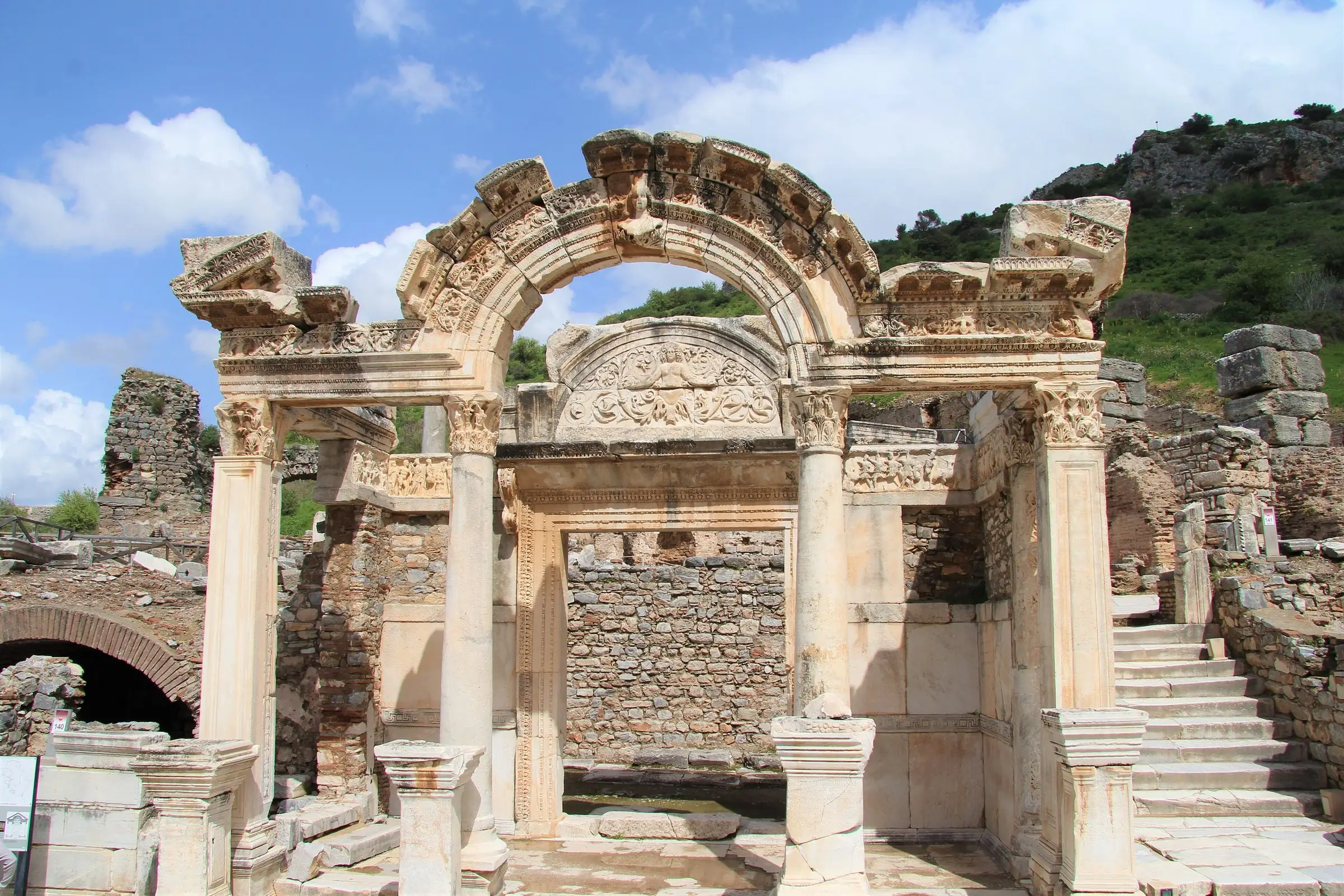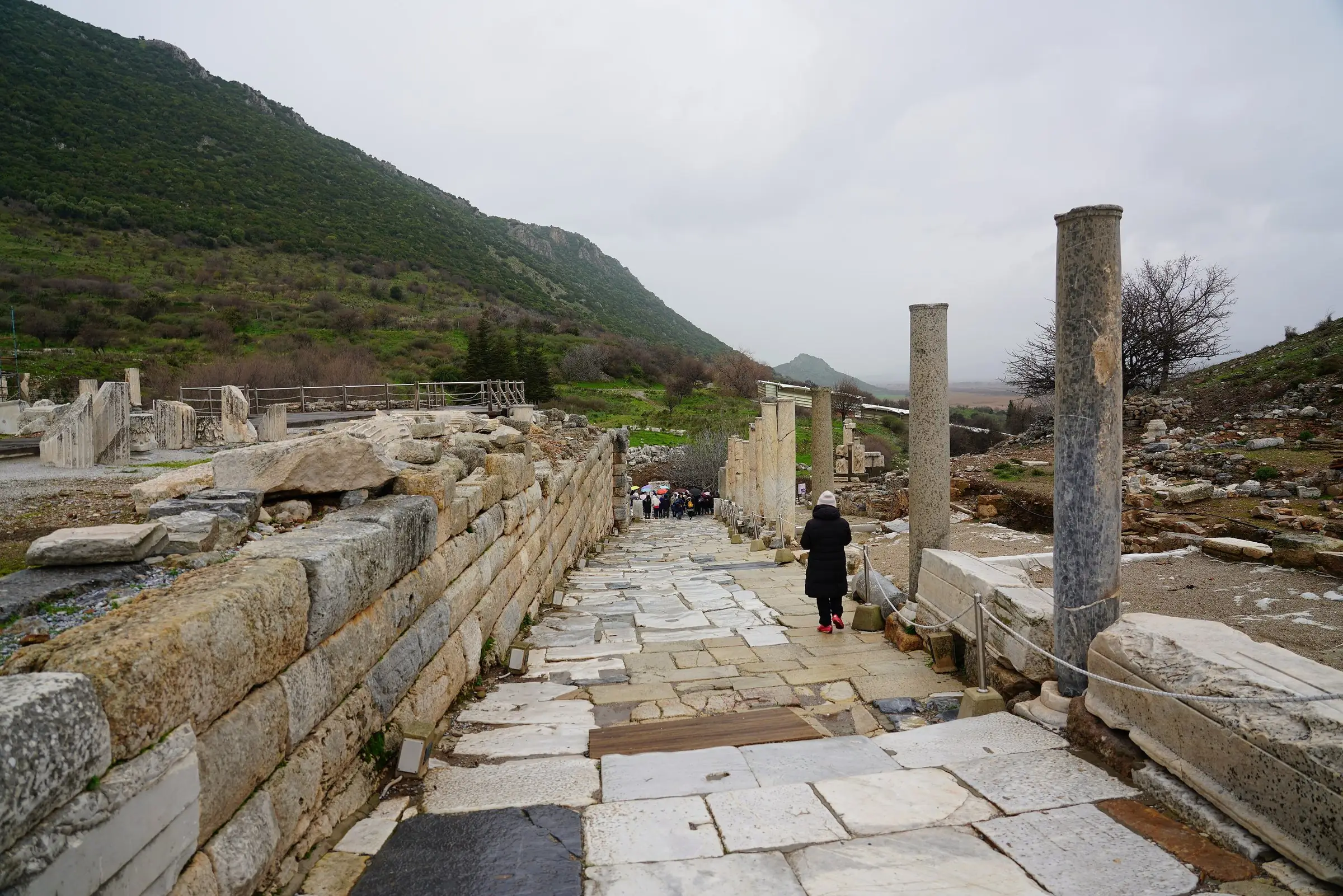
This is the street on every postcard, and unusually for a postcard it deserves it. Curetes Street falls about thirty-five metres in four hundred, straight down the valley between two hills, and everything the city was proud of is arranged along it: the fountains, the baths, the covered pavements with their mosaic floors, the shops behind them, the honorific statues on both kerbs.
The name is modern shorthand. The Curetes were a college of priests, and their membership lists were carved on columns that were later reused along this street — so the street is named after a set of inscriptions that were never meant to be here.
Watch the paving
The marble is genuinely slippery. Two thousand years of feet have polished the slabs smooth, and the gradient does the rest; the worst of it is the middle third, where the stone is oldest and the slope steepest. People go down every day, and almost always in shoes with no grip.
Walk on the rougher stone at the edges where you can, and if it has rained in the last few hours, take the gravel margin instead. See what to wear and bring for the rest of it.
The Trajan Fountain
About halfway down on the left, a two-storey façade with a small pool in front of it and a single foot the size of a chair. That foot belonged to a statue of Trajan that stood over the basin, and the inscription under it quoted the emperor as saying that everything under the sun was Roman.
The globe he stood on is gone. The foot is a cast; the original is in the museum in Selçuk.
The latrines
Behind the Scholastikia Baths, one of the most popular rooms at Ephesus: a square court with a continuous marble bench running along three walls, each seat a keyhole cut into the stone, a channel of running water below and a shallow gutter in front for the sponge.
There was no privacy and nobody expected any. The floor is mosaic, there was a pool in the middle, and the seats over the corner drains were the ones you gave to someone you did not like.
The baths, and the woman who paid for them
The Scholastikia Baths were rebuilt around AD 400 by a Christian woman named Scholastikia, whose headless statue still sits in the entrance. Her name is on the base. A large public bath complex, refitted by a private citizen four hundred years after the street was laid out, is a good measure of how long Ephesus kept working.
The houses on the slope
Above the street on the left, under a modern roof, are the Terrace Houses — the separate-ticket part of the site. The entrance is on Curetes Street itself, about two-thirds of the way down, and it is easy to walk past.
What you arrive at
The street ends where the ground flattens, and the Library of Celsus is directly in front of you. This is the single best argument for starting at the Upper Gate: walk the site downhill and the library arrives as a view. Walk it uphill and it is behind you before you have looked at it.
How long is Curetes Street?
About 400 metres, falling roughly 35 metres from Domitian Square to the Library of Celsus. Ten to fifteen minutes downhill without stopping; twenty-five to thirty if you look at things.
Is Curetes Street slippery?
Yes, in the middle section especially. The marble has been polished by two thousand years of use and the street is on a gradient. Walk on the rougher edges, and be careful in the first hour after rain.
Are the Ephesus latrines still there?
Yes — a square court with the marble bench and its keyhole seats intact, behind the Scholastikia Baths on the lower half of Curetes Street. It is one of the busiest spots on the site.