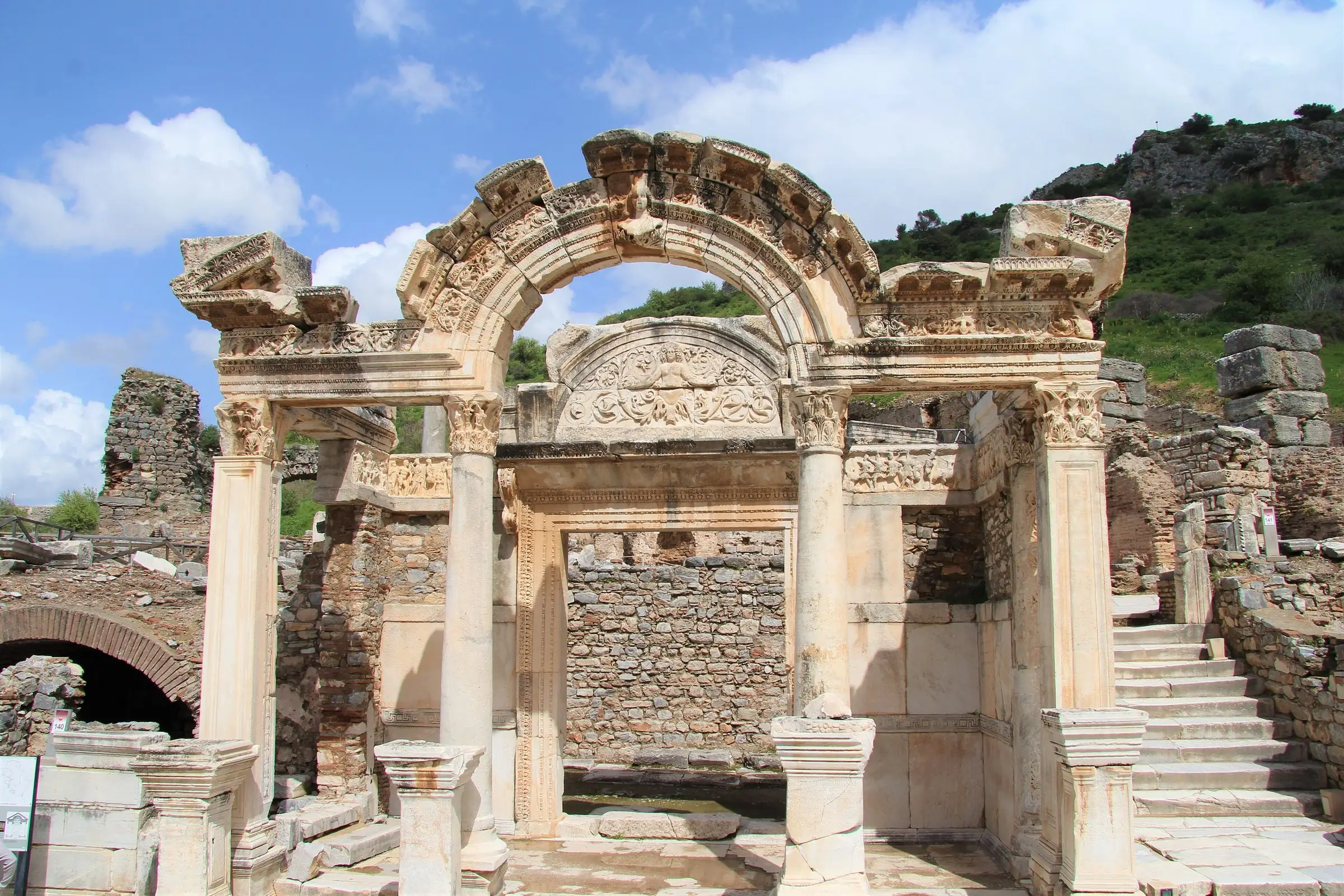
It is the most photographed thing on Curetes Street after the library, and it is smaller than the photographs suggest — the porch is about eight metres across. What makes it work is the arch. Instead of a flat lintel across the two central columns, the builder sprang a shallow arch, and set a bust of Tyche, the fortune of the city, at its crown. It is a small idea, beautifully executed, and it turns up all over later Roman architecture.
What it actually was
An inscription on the architrave dedicates it to Hadrian, to Artemis and to the people of Ephesus, and names the man who paid: Publius Quintilius. The date is around AD 138.
Whether it was a temple in any full sense is doubtful. There is no room behind the porch for the usual apparatus of a temple; it reads more like a monumental shrine on the street front, of the kind a rich citizen put up to honour an emperor and be seen doing it.
Almost everything you can see is a copy
The four relief panels in the porch are casts. So is the Tyche head, and so is the Medusa in the inner doorway. The originals are in the Ephesus Archaeological Museum in Selçuk, ten minutes away, and they are worth the trip: at eye level and out of the sun, the carving is a different object.
The panels are also not all the same age. The three that show the foundation myths of Ephesus — Androklos and the boar, Dionysos in procession, Amazons — belong with the building. The fourth, a row of standing figures, was added in the fourth century AD and is generally read as the emperor Theodosius I with his family. Two hundred and fifty years of use, and the building was still worth updating.
Where to stand
Directly in front and slightly to the left, from the middle of the street, with the columns of the Scholastikia Baths behind you. Around eleven in the morning the sun is on the façade; by mid-afternoon it has gone behind the hill and the porch is in flat shade, which is better for the carving and worse for the photograph.
Are the reliefs on the Temple of Hadrian originals?
No. The panels in the porch, the Tyche head on the arch and the Medusa in the doorway are all casts. The originals are in the Ephesus Archaeological Museum in Selçuk.
Who built the Temple of Hadrian at Ephesus?
A citizen named Publius Quintilius, around AD 138, according to the dedication on the architrave. It honours Hadrian, Artemis and the people of Ephesus.