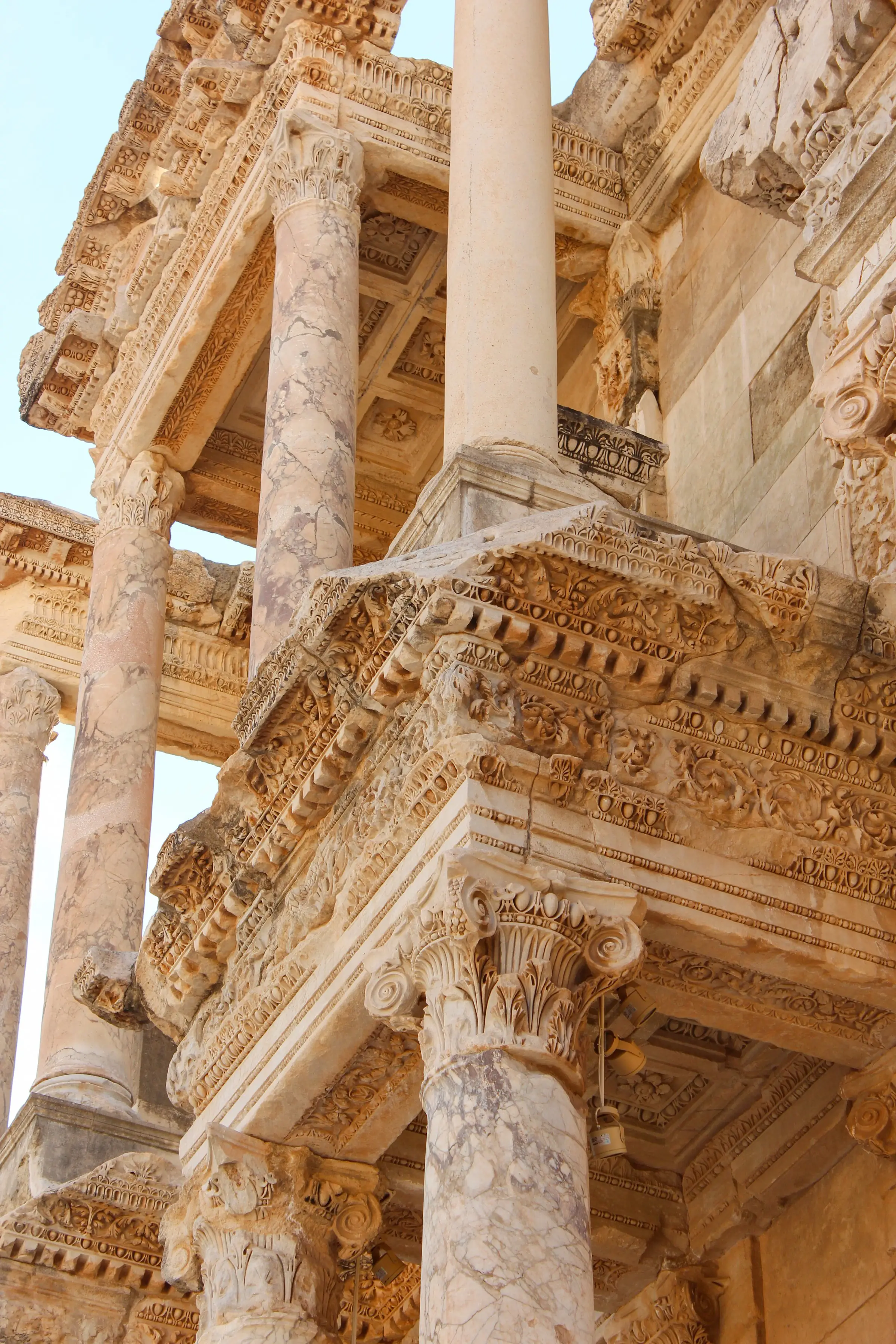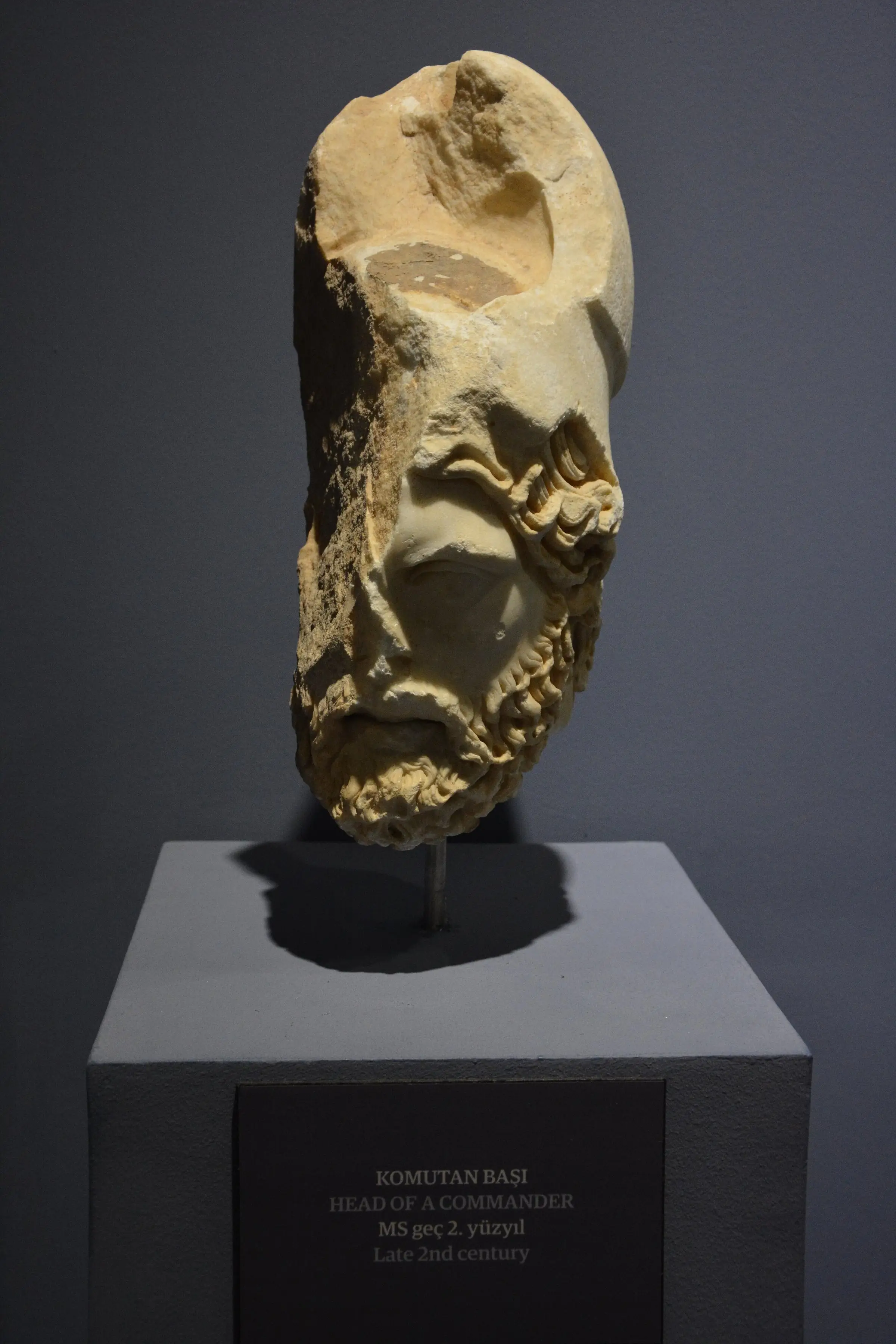
The reason Ephesus mattered was not the harbour. It was the goddess.
Not the Greek Artemis
The Artemis of Ephesus is a different figure from the huntress of Greek myth, and the Greeks knew it. She is older, local, probably continuous with an Anatolian mother goddess who was worshipped on the site long before Ionian settlers arrived, and the Greeks did what they usually did: matched the local deity to the nearest name in their own system and carried on.
Her cult statue — there are three great versions in the Ephesus Archaeological Museum — is unmistakable. A rigid, columnar figure, arms held out, wearing a garment covered in animals, and across the chest rows of ovoid objects.
Nobody has settled what those are. They have been read as breasts, as bull testicles hung on the statue as offerings, as eggs, as amber gourds, as the fruit of a date palm. The oldest interpretation is the breast one and it may well be right; it is also the one most confidently asserted by people who have not looked at the argument. Take it as unresolved and enjoy it.
The temple
The Artemision stood on the plain about two kilometres from the city centre — Greek temples of this scale were often set apart from the town — and it was rebuilt several times on the same spot.
The version that made the Seven Wonders list was begun around 550 BC, funded partly by Croesus of Lydia, and was among the first Greek temples built entirely of marble. It was enormous: roughly 115 by 55 metres, with well over a hundred columns, some carved with figures around their bases.
Antipater of Sidon, who wrote the list, said that when he saw it the other wonders were put in the shade.
The fire
In 356 BC a man named Herostratus set fire to the temple, and said under torture that he had done it so his name would be remembered. The Ephesians made it a capital offence to speak that name, which has worked out about as well as such measures usually do.
Ancient writers noted that the fire happened on the night Alexander the Great was born, and explained that Artemis had been away attending the birth. Alexander later offered to pay for the rebuilding if his name went on the dedication; the Ephesians declined, with the excellent line that it was not fitting for one god to build a temple to another.
They rebuilt it anyway, larger, on the same plan.
The end
The Goths destroyed it in AD 262. It was not rebuilt again. Christianity was rising in Ephesus, the temple's income and standing had gone, and by the fifth century the site was a quarry: cut marble is worth more as building material than as a ruin.
What is there now
A boggy field with a single column standing in it, reassembled in the 1970s from drums that did not necessarily belong together, at roughly the height of the original. Storks nest on it in season.
It is free, it is five minutes off the road between Selçuk and Ephesus, and the usual reaction is disappointment followed by something better. From the column you can see, in one view, the whole of what happened here: the Artemision in the foreground, the Basilica of St John on the hill above it, the İsa Bey Mosque below that, and the fortress on top. Four religions, in the order they arrived, in a single line of sight.
The best surviving fragments — the carved column drums — are in the British Museum, dug out by John Turtle Wood, who spent six years from 1863 looking for the temple before an inscription in the theatre told him where to dig.
One thing that is not true
You will hear that the green columns in Hagia Sophia came from the Temple of Artemis. It is a good story, it is very widely repeated, and there is no evidence for it.
What happened to the Temple of Artemis at Ephesus?
It was burned in 356 BC, rebuilt larger, destroyed by a Gothic raid in AD 262, and then quarried for its marble. One reassembled column stands on the site.
Why is Artemis of Ephesus shown with many breasts?
Nobody has established what the ovoid forms on her chest are. Breasts, bull testicles, eggs and amber gourds have all been argued. Treat the question as open.
Can you visit the Temple of Artemis?
Yes, and it is free. It is a field with one standing column, five minutes from the road between Selçuk and Ephesus.