Ephesus was the commercial capital of Roman Asia. Pergamon was what it replaced — the royal city of the Attalid kings, and for a century and a half the most ambitious cultural project in the eastern Mediterranean.
Going to both changes what you understand about either.
What is up there
The theatre. Cut into the side of the acropolis at an angle no other ancient theatre attempts: 78 rows rising some 36 metres, about ten thousand seats, and a drop from the top that is genuinely alarming. Because the hill left no room for a normal orchestra, the stage was a wooden structure erected for each season and dismantled after it. There is nothing else like it.
The Temple of Trajan. White marble on the summit, re-erected by German archaeologists, and visible from the town below.
The library. Second only to Alexandria, and the reason for the word parchment: when Egypt cut off the papyrus supply — the story goes, to stop Pergamon competing — the city developed prepared skin instead, charta pergamena.
The Great Altar. Not there. It is in Berlin, in the museum named after it, and the empty terrace where it stood is one of the strangest sights in Türkiye.
The Asklepion
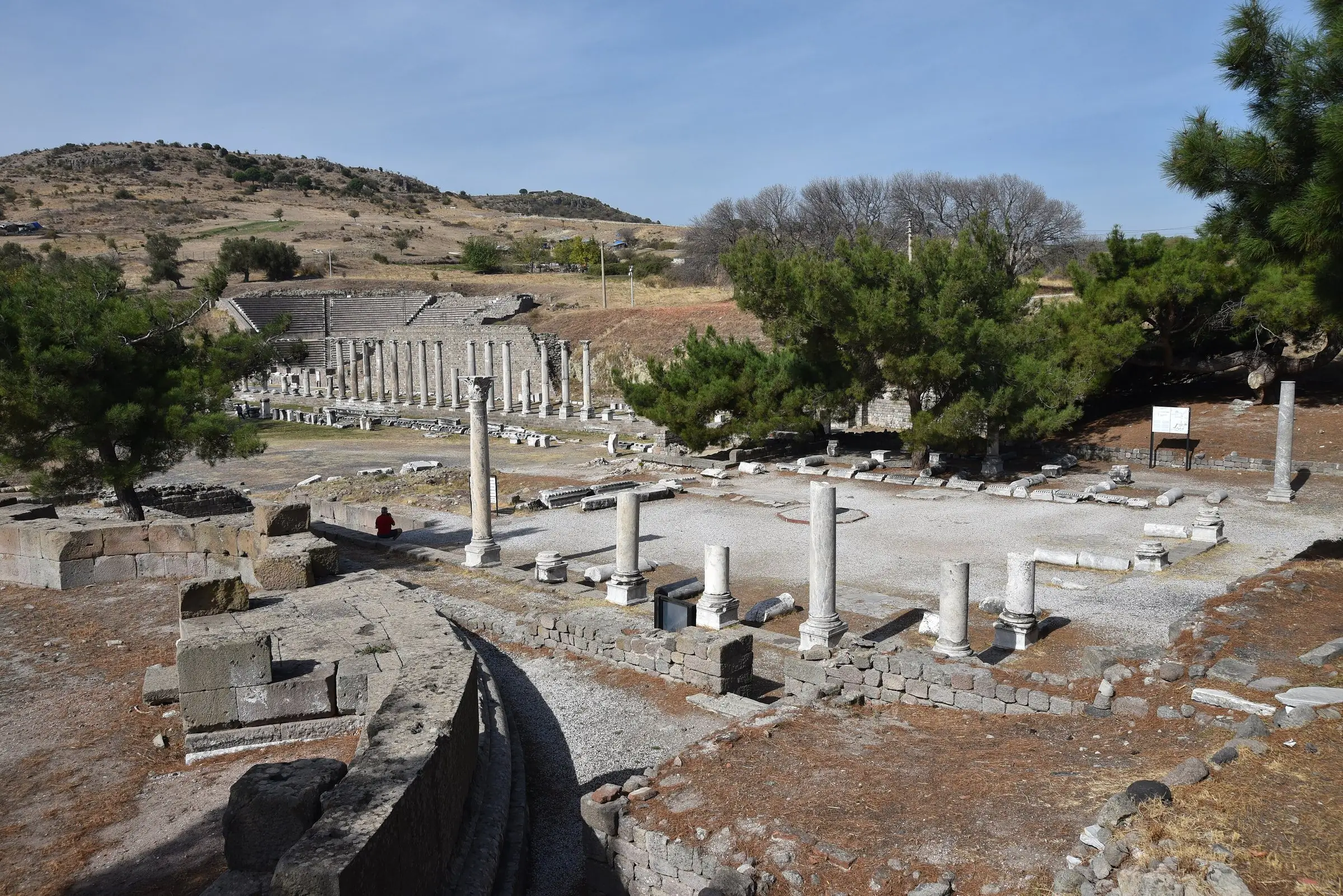
Down on the plain, a separate site and for many visitors the better one: a sanctuary of Asclepius that worked as a hospital, a spa and a temple at once. Patients came for years. Treatment involved sleeping in the precinct so the god could prescribe through a dream, and also mud, water, exercise, diet and theatre.
Galen — physician to Marcus Aurelius, and the man whose medical writing governed European practice until the Renaissance — was born in Pergamon and worked here, treating gladiators.
You walk in along a colonnaded sacred way, through a tunnel with holes in the roof through which the priests' voices reached patients being led along it, and out into a court with a theatre on one side.
Getting there
- From Selçuk or Ephesus: about 180 km, two and a half hours each way by road.
- From Kuşadası: add half an hour.
- From İzmir: about two hours, which is why Pergamon is an easier day from İzmir than from anywhere in the Ephesus area.
There is a cable car from the edge of Bergama to the acropolis. Take it. The road up is long and the walk down through the site is the good direction.
Both sites charge separately, and the Museum Pass covers them.
Honestly: should you?
Not on a cruise call from Kuşadası. Five hours in a vehicle out of a nine-hour day is not a visit.
Not as your only other site if you have two days and have not yet seen the Ephesus Archaeological Museum or Şirince. Those are twenty minutes away and Pergamon is five hours of driving.
Yes if you have three days or more, or if you have been to Ephesus before, or if the ancient world is the reason you came to Türkiye. The acropolis at Pergamon is the single most dramatically sited ruin in the country, and the Asklepion is the most interesting.
Start early. It is a full day and the last hour of light on the acropolis is the one worth having.
How far is Pergamon from Ephesus?
About 180 km, two and a half hours each way by road from Selçuk. It is roughly two hours from İzmir, which makes it an easier day from there.
Can you visit Pergamon on a cruise day from Kuşadası?
It is sold, but five hours in a vehicle out of a nine-hour call leaves very little visit. Ephesus is twenty-five minutes away.
Is the Pergamon Altar still there?
No. It is in the Pergamon Museum in Berlin. The terrace where it stood is empty, and seeing that is its own experience.
Is the cable car at Pergamon worth taking?
Yes. It saves a long climb and lets you walk down through the site, which is the better direction.