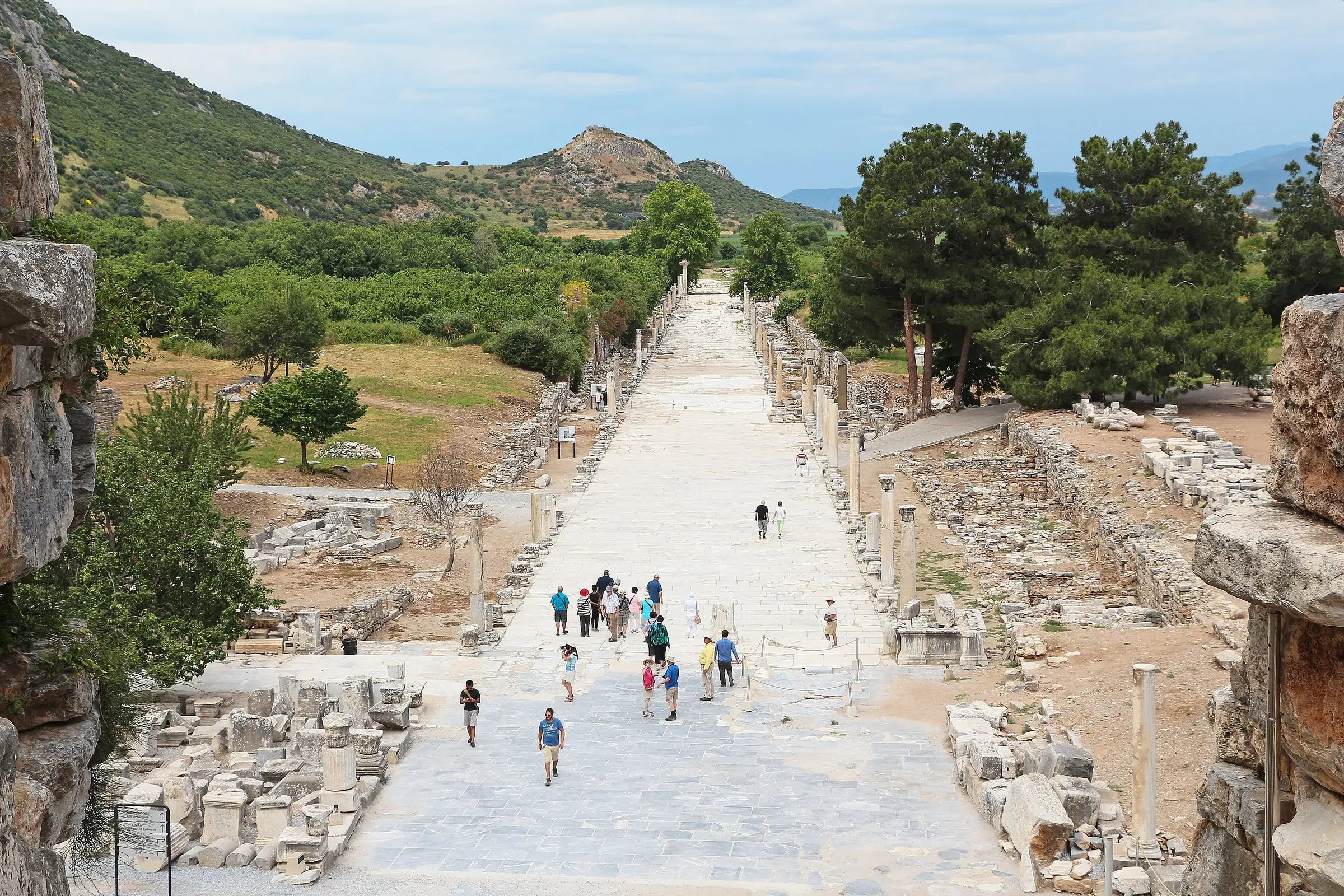
Stand at the top of the Great Theatre and look west along Harbour Street. The road runs dead straight for half a kilometre and then stops in a flat green plain with a line of trees across it.
That plain is the answer. It used to be water.
A city built on a harbour
Ephesus existed because ships could reach it. It sat at the mouth of the Cayster — the Küçük Menderes — where a river valley met the Aegean, and it was the natural point of transfer between sea traffic and the roads inland to Sardis, Phrygia and eventually Persia. Under Rome it became the capital of the province of Asia and, for a while, one of the great ports of the eastern Mediterranean.
Everything about the city's plan assumes the sea. The theatre faces the harbour. Harbour Street was built to be the first thing a visitor saw walking off a ship.
The river never stopped
The Cayster drains a wide agricultural valley, and it carries silt. In a natural estuary that silt spreads out; in an enclosed harbour basin it settles.
The Ephesians knew. They dredged, repeatedly. They moved the harbour, more than once, downstream as the coastline advanced. Under Attalus II of Pergamon, in the second century BC, they narrowed the harbour mouth to increase the scour — a sound piece of hydraulic engineering that, according to Strabo, made the problem worse by trapping silt inside.
The rate matters more than any single event. Deforestation and intensive farming in the valley raised sediment loads; the coastline advanced perhaps a few metres a year, for centuries. There is no year in which Ephesus lost its harbour. There is only a slope, and at some point on it the port stopped being worth the dredging.
Today the sea is about five kilometres west of where it was.
The other things that happened
Silting decides the ending; it does not explain the timing. Several shocks landed on a city that was already becoming a river town.
AD 262. A Gothic raid destroyed the Temple of Artemis and burned a good deal of the city, including the interior of the Library of Celsus.
The fourth and fifth centuries. Ephesus remained important — the Church of Mary near the harbour hosted the Council of Ephesus in AD 431 — and Harbour Street was rebuilt in grand style around AD 400. This was not a dying city yet.
The sixth and seventh centuries. Plague, earthquakes, and the collapse of the eastern Mediterranean economy. The population contracted towards the hill of Ayasuluk, where the Basilica of St John and a defensible fortress were.
AD 654–655, 700, 716. Arab raids on the coast. A city with no harbour and no walls that could be held was not defensible.
The move to the hill
By the eighth century the settlement had shifted to Ayasuluk, two kilometres away — higher, walled, and grouped around the tomb of St John. That town survived, changed hands, became Turkish in the fourteenth century under the Aydınoğulları, acquired the İsa Bey Mosque, and is now called Selçuk.
So Ephesus was not abandoned in the way Pompeii was. It moved, slowly, uphill and inland, and the part it left behind is what you walk through.
How big was it, actually
You will be told a quarter of a million people. That figure comes from taking the theatre's 25,000 seats and multiplying by a rule of thumb.
Modern estimates based on the built area — about 224 hectares of it — and defensible population densities give something between roughly 34,000 and 56,000. Still one of the larger cities of the empire. Not the third largest city in the world.
It is a good corrective for the whole site: Ephesus was extraordinary without needing to be exaggerated.
Why was Ephesus abandoned?
Its harbour silted up. The Cayster river filled the basin faster than the city could dredge it, and without a working port the reason for the city went. Raids and earthquakes finished a decline geography had already decided.
How far is the sea from Ephesus now?
About five kilometres. Harbour Street, which ended at the docks, now runs out into a farmed plain.
Was Ephesus destroyed by an earthquake?
Earthquakes damaged it repeatedly and brought down the façade of the Library of Celsus, but they did not end the city. The harbour did.