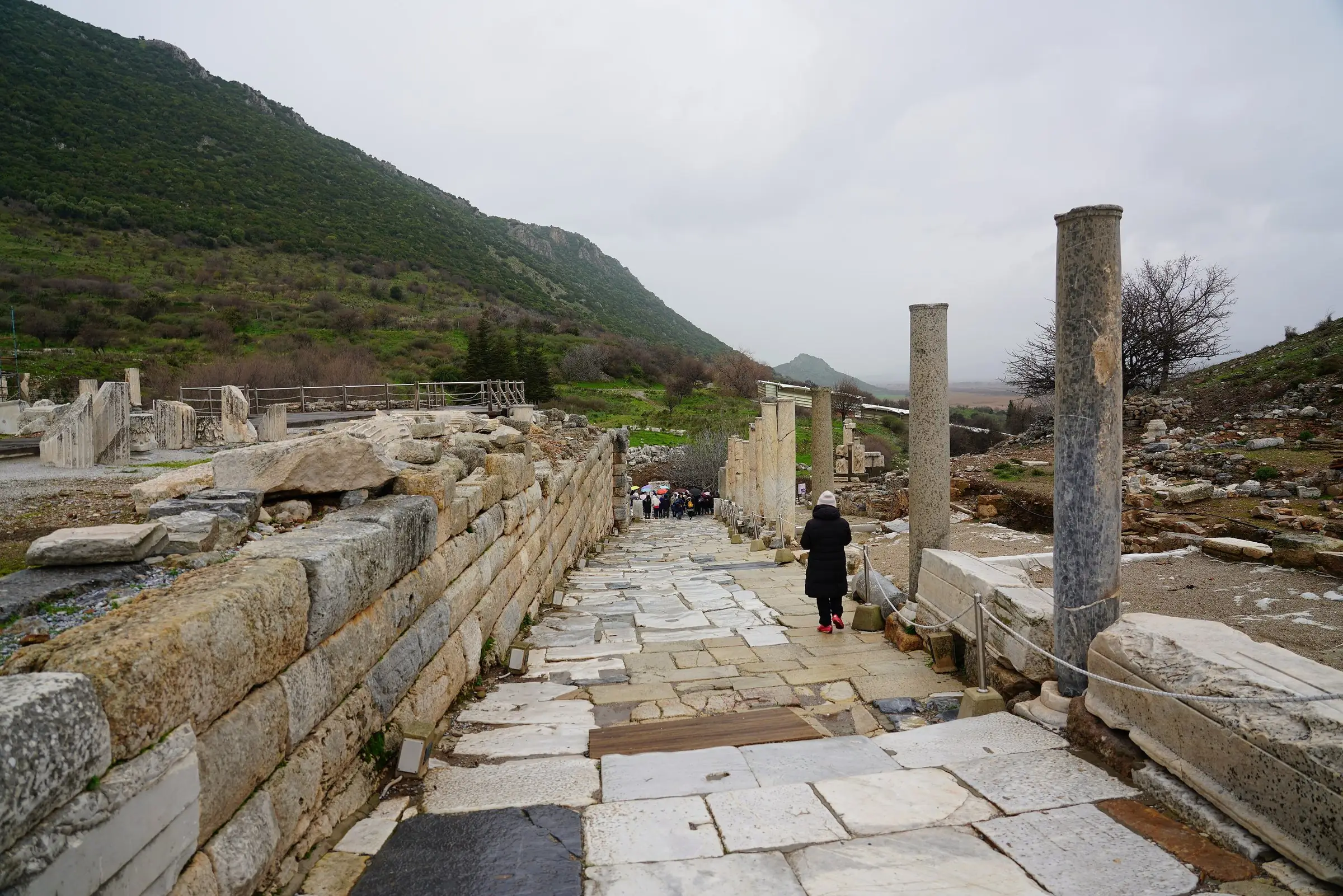
Coming in at the Upper Gate you walk two hundred metres of dust and low walls before anything looks like a city. Then the ground opens on the left into a long rectangle of column stumps, and on the right into a small theatre cut into the slope. Almost everybody photographs the theatre and keeps going.
That is a reasonable use of a hot morning. But this end of the site is the only part of Ephesus that was never really about visitors — no shops, no fountains laid on for the crowd, no façades built to be seen from below. It is the part where the city ran itself.
The Odeon
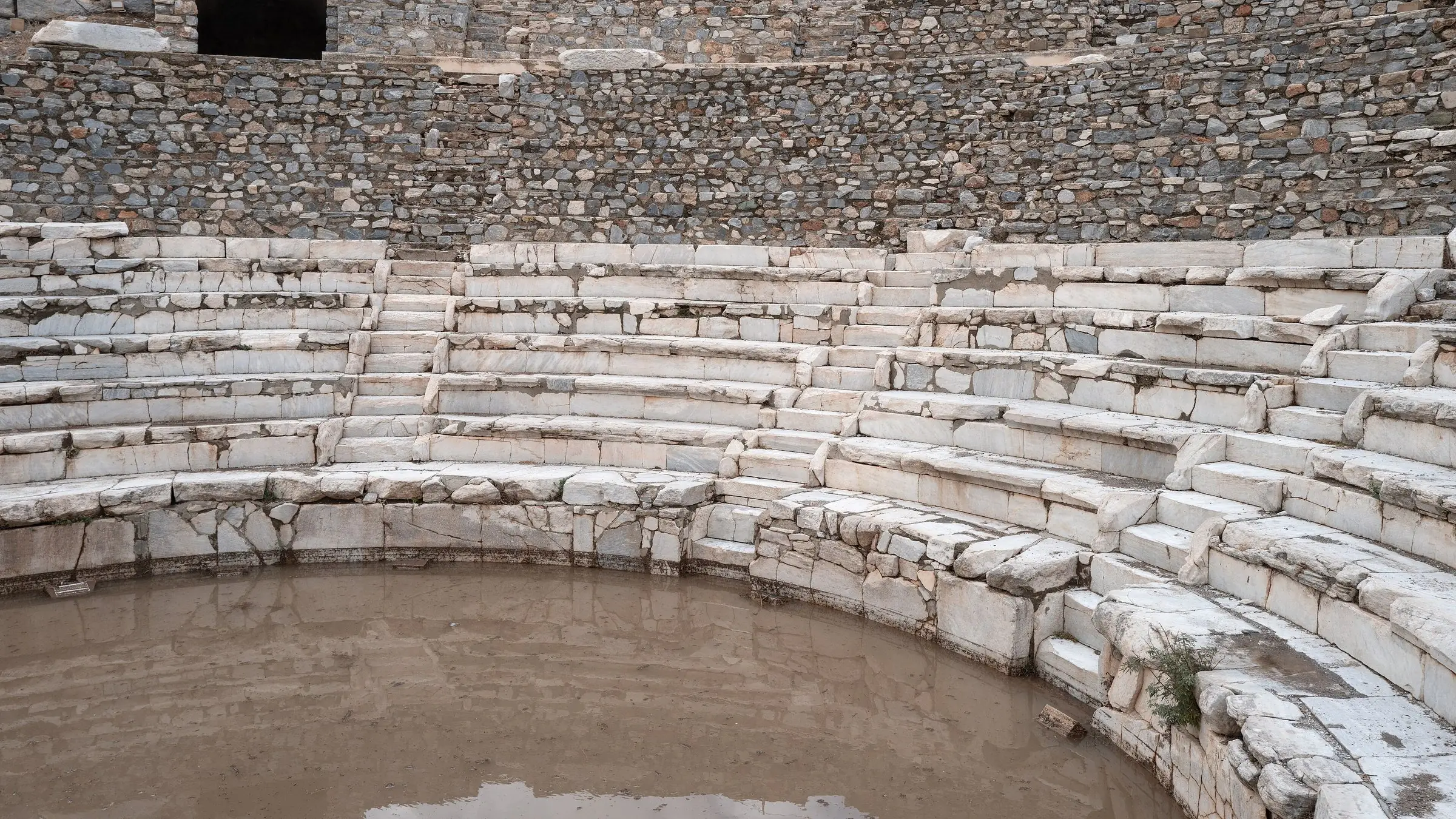
It seats about 1,500 and it had a roof, which is what makes it an odeon rather than a theatre. The seating is cut in two tiers with a walkway between them; the marble facing has mostly gone, so what you climb now is the rough core.
An inscription names the builders: Publius Vedius Antoninus and his wife Flavia Papiana, around AD 150. Vedius was a local grandee of the sort Ephesus produced in quantity — rich enough to pay for public buildings, ambitious enough to want his name on them. It worked. We still know who he was.
The building did two jobs. The council of Ephesus met here, and it was also used for recitals and lectures, which is why you will see it called both bouleuterion and odeon. Sit near the top and speak normally to someone at the bottom. It still works.
The State Agora
The long open rectangle opposite is not a market. Ephesus had a market — the Commercial Agora, twenty-five minutes downhill — and this is the other kind of agora: a civic square, 160 metres by 58, laid out in the first century BC over an older cemetery. Assemblies, ceremonies, statues of people the city wished to thank.
Under the middle of it, excavators found a small temple of the Augustan period, and at the eastern end a basilica — a covered hall running the length of the square, the ancient equivalent of a colonnaded arcade where business got done out of the sun.
The Prytaneion
At the north-west corner, behind the Odeon, are the remains of the Prytaneion: the city hall, where the sacred flame of Hestia Boulaia was kept alight and where visiting dignitaries were fed at public expense.
This is the most quietly important set of stones at Ephesus. Two of the three great statues of Artemis in the Ephesus Archaeological Museum in Selçuk were found here, buried — probably hidden in the fourth century when the temples were being closed and their contents were worth destroying. If you go to the museum afterwards, this is the room they came out of.
Domitian Square and the way down
Past the Odeon the ground begins to fall away, and this is where the walk properly starts. On the terrace to the right stood the Temple of Domitian, the first temple in Ephesus dedicated to a living emperor — an honour that let the city call itself neokoros, temple-warden of the imperial cult, and put it on its coins for three hundred years. Domitian was assassinated and his memory formally condemned; the temple was quietly rededicated to his father, Vespasian.
At the head of the slope are two things worth thirty seconds each. The Memmius Monument, a square block of masonry raised by a grandson of the dictator Sulla, whose troops had sacked the city in 84 BC — a monument put up by the family of the man who punished you is a particular kind of civic tact. And the Pollio Fountain, whose broken arch frames the view down the hill.
Then the paving changes, the columns begin, and you are on Curetes Street.
Can you sit in the Odeon at Ephesus?
Yes. The lower rows are open and people sit there; the upper seating is fenced in places where the core is unstable. It is one of the few shaded-ish places near the Upper Gate early in the morning.
How long does the upper part of Ephesus take?
Ten to fifteen minutes from the Upper Gate to the head of Curetes Street if you stop at the Odeon and glance at the State Agora. Most guided groups do it in eight.