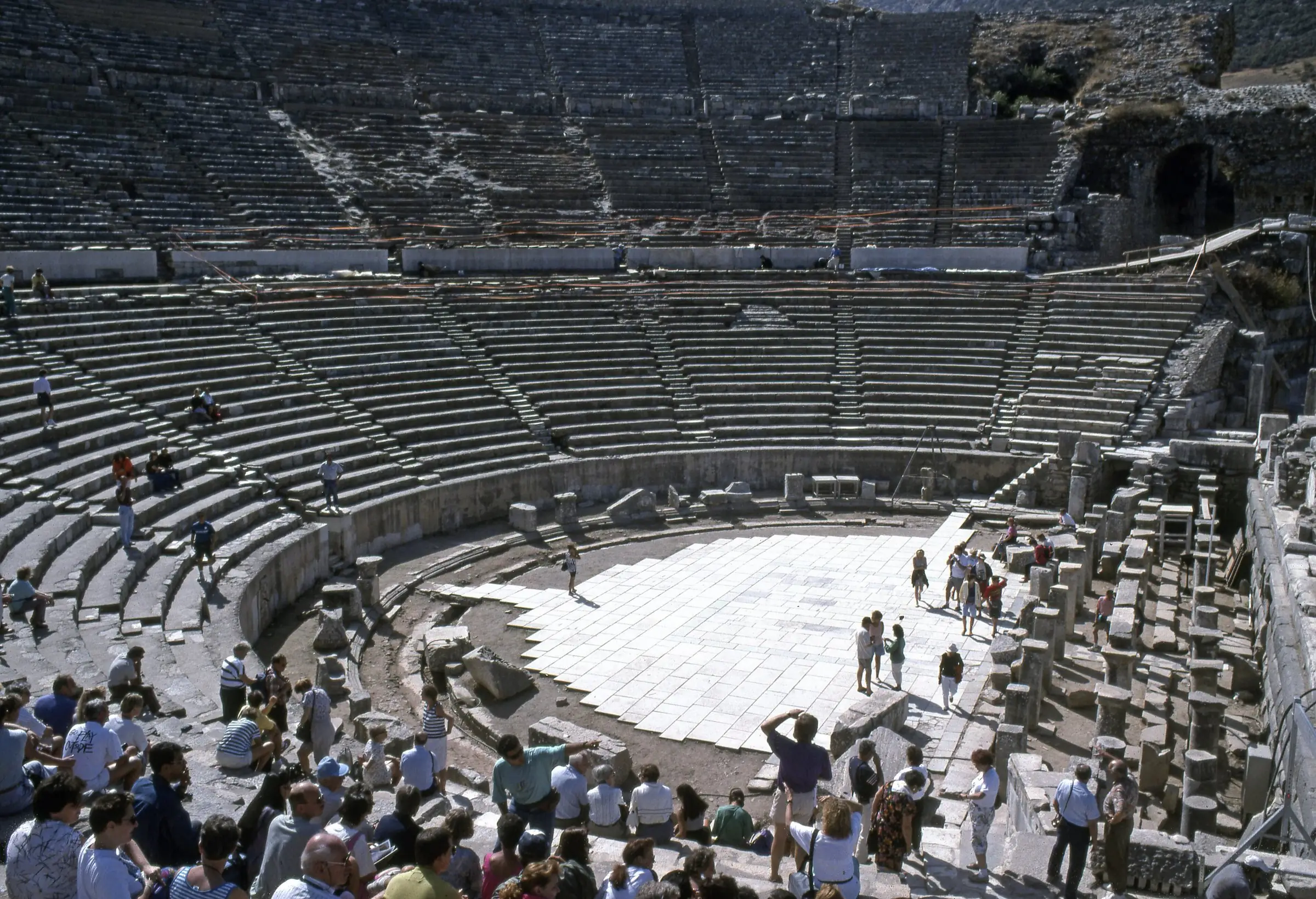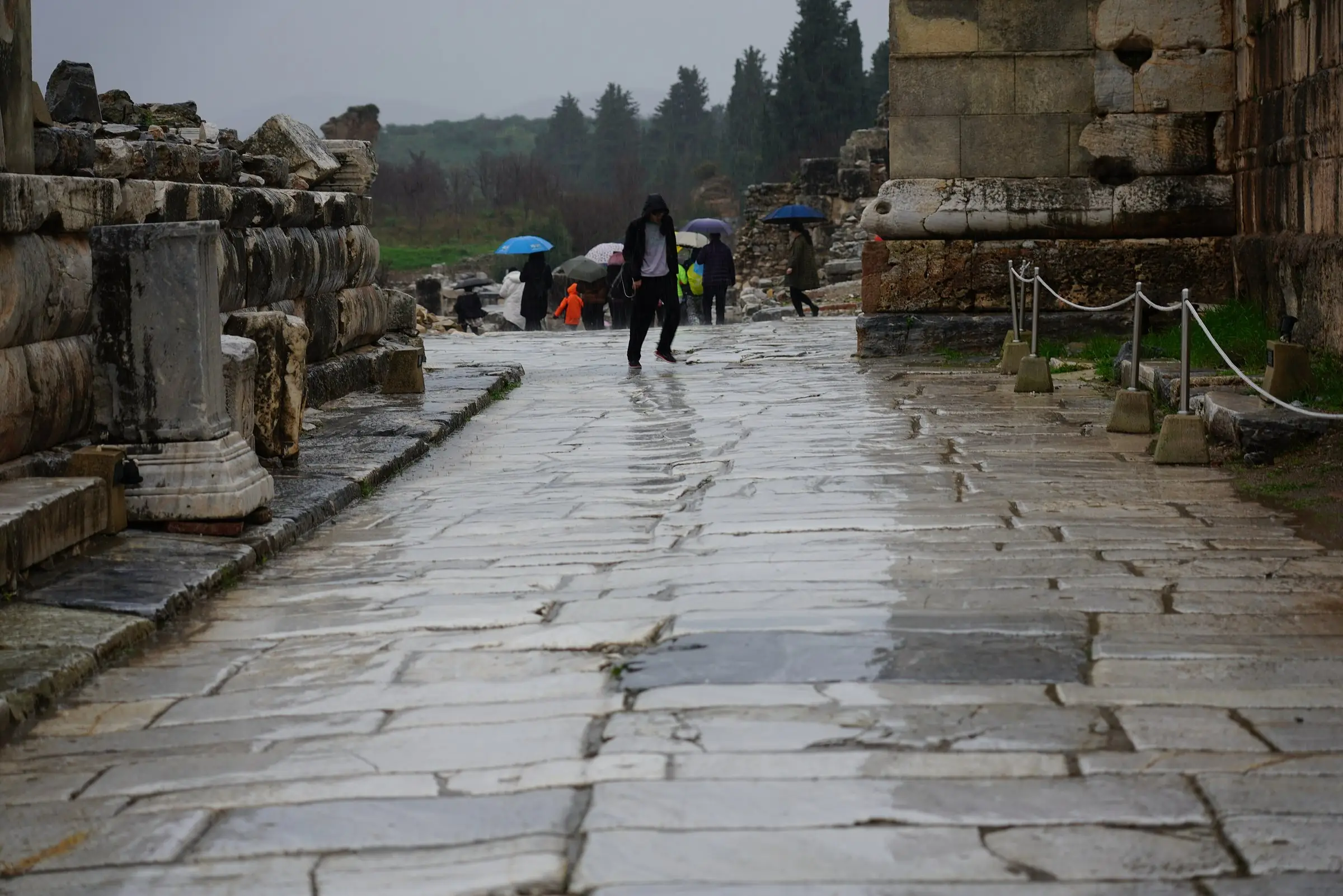
Turn left at the library and the character of the site changes. The tight, theatrical descent of Curetes Street is behind you; ahead is a broad, flat, brutally functional road with a colonnade down one side and a drop into the agora on the other.
The gate
Before you leave the square, look at the triple arch on the right of the library. It was built in 4–3 BC by Mazeus and Mithridates, two freedmen of the emperor Augustus, who put up a public gate to honour the man who had freed them. The Latin inscription is still legible across the architrave.
It is the main entrance to the Commercial Agora, and it is the best small piece of Augustan architecture on the site.
The Commercial Agora
Through the gate is a square of about 110 metres a side, once surrounded on all four sides by a two-storey colonnade with shops behind it. This was the market: grain, cloth, slaves, everything a port city moved.
Very little of the superstructure stands, which is why most people cross it in ninety seconds. It is worth standing in the middle of it once. Ephesus was a city of maybe fifty thousand people — not the quarter of a million you will be told — and this square is where most of them did business.
Marble Street
The road running north from the library is called Marble Street for the obvious reason. It was the processional way: at the great festivals the images of Artemis were carried from her temple, through the city, into the theatre and back.
What you walk on is late. In the fifth century AD the whole street was raised and repaved, and the covered colonnade on the eastern side — the raised platform with the column bases — was added then. Under it runs the main drain, with inspection holes you can still see in the paving.
The footprint
About halfway along, on the left-hand slab as you walk down, someone carved a left foot, a female head, a heart shape and a rectangle that is usually read as a book or a purse.
The standard explanation is that it advertised the brothel across the street: follow the foot, and if your own foot was smaller than the carving you were too young. It is a good story and it is repeated everywhere, including by guides who know better.
What is actually certain is that the carving exists, that it is on the processional street, and that nobody has established what it meant. The building opposite that gets called the brothel is a large private house or a bath complex; the identification comes from an eighteenth-century guess and a statue of Priapus found in a drain. Treat the whole thing as a nice puzzle rather than a fact.
The seats
Along the colonnade platform, cut into some of the marble blocks, are grids of squares and lines. These are game boards — the Roman equivalent of scratching a noughts-and-crosses grid on a bench while you wait. They are the most human thing on the site, and almost everybody walks over them.
What is the footprint carved on Marble Street?
A left foot, a female head and a couple of other marks cut into a paving slab. It is usually explained as an advertisement for a brothel, but nobody has established what it actually meant.
Was there really a brothel at Ephesus?
The building called the brothel is more likely a large private house or part of the bath complex. The name comes from an early guess and a statue found in a drain.